


- Mettre en route la vidéo
- Cliquer sur l’icône « CC » (Sous-titre) en bas à droite
- Cliquer sur l’icône « Settings » (Paramètre) en bas à droite
- Cliquer sur «Subtitles » (Sous-titres)
- Cliquer sur « Auto-translate » (Traduire automatiquement)
- Sélectionner la langue de votre choix
From Illness to Action: A Family’s Story Sparks a Community Movement
At 22 years old, Hillary Russell found herself navigating a world newly reframed. On a recent episode of Southwest Magazine on CHCO-TV, host Vicki Hogarth spoke with Russell about how her mother’s breast cancer diagnosis became the pivot point for a project, a campaign—and perhaps, a deeper sense of purpose that continues to shape her young life.
Early in 2025, Hillary’s mother, Cheri Russell, was diagnosed with breast cancer at the age of 50. The timing, Hillary recalled, felt almost cinematic in its abruptness. She was finishing her final semester of university in Fredericton, preparing to step into a career, while her younger brother Sawyer was juggling his commitments as a competitive hockey player. Suddenly, the family’s daily rhythm shifted from school schedules and hockey practices to hospital visits, rest days, and the careful balancing act of optimism and fear that defines life after a serious diagnosis.
In the midst of that uncertainty, Hillary turned to what she knew best—art. As part of a university course titled Images and Insights, she decided to document one particular weekend in March 2025, just before her mother’s chemotherapy began. Cheri had asked for a celebration before the long months of treatment ahead, and the family gathered with friends for three days of music, dancing, laughter, and quiet reflection. Hillary’s camera became both witness and participant. Her photo essay captures the details often lost to memory: the pile of shoes by the front door, the hum of conversation from a crowded kitchen, the reflection of her mother in a mirror—poised, strong, moments before her hair began to fall. Hillary described the project as both intimate and ordinary, writing simply, “Motherhood doesn’t pause for illness.”
What began as a course assignment quickly became something larger. The photographs, bound by honesty and tenderness, now stand as a lasting document of resilience, joy, and the ways families hold fast when faced with the unknown. For Hillary, it was more than art—it was a language through which she could process fear and express love.
The conversation on Southwest Magazine also explored the ways identity shifts under the weight of crisis. In a matter of months, Hillary’s roles multiplied—student, daughter, artist, fundraiser, and emotional anchor. Meanwhile, her mother, once the constant source of strength, had to learn new forms of acceptance: allowing others to help, drawing boundaries, and redefining what independence looked like. “Her sense of identity has definitely shifted,” Hillary reflected. “To watch her have to learn how to create boundaries and how to say no to things, and also how to let people help her—it’s been inspiring. She’s obviously still killing it as a mom.”
Amidst these changes, Hillary found herself drawn back to a local tradition with deep personal roots: Ra Ra for the Tatas, a community fundraising initiative for breast cancer awareness. The original campaign was founded in 2009 by a group of friends honouring mothers lost to cancer. In 2025, Hillary took the reins to revive the effort under a new name—Ra Ra for the Tatas 2.0—as both a tribute to those original women and a symbol of continuing action. The campaign will culminate in the CIBC Run for the Cure on October 5, a national event that unites survivors, families, and supporters in shared solidarity.
“Mom was asked to lead the first lap for the Participants of Hope, which are the participants who have or have had breast cancer,” Hillary said, her pride unmistakable.
In the weeks leading up to the run, Hillary organized Sing for the Cure at Drewhaven in St. Andrews—a blend of open-mic performances and a silent auction showcasing local artists. She even took to the stage herself, channelling emotion into song. The event was more than a fundraiser; it became a community gathering, a space for both expression and empathy.
Throughout the interview, Hillary also spoke openly about the hidden financial toll of cancer. “It’s expensive to be sick, and it’s shocking how expensive it is,” she said. Beyond the physical challenges, she emphasized the logistical and emotional costs—travel, fuel, food, medications—all of which pile up quietly, often out of sight from those not directly affected.
Her mother’s treatment plan evolved. What doctors first thought might involve a single mastectomy became a longer process—six cycles of chemotherapy, followed by surgery and further treatment. Cheri also underwent cold cap therapy at Charlotte County Hospital, a difficult and often painful method used to preserve hair during chemotherapy. Despite the discomfort, she persisted, seeing it as a way to maintain a piece of her identity through the ordeal.
When the family finally decided to share Cheri’s diagnosis publicly—shortly after she rang the bell marking the end of a chemotherapy round—the outpouring of support was overwhelming. Friends, former students, colleagues, and neighbours reached out. Others who had faced similar battles sent messages of encouragement. For Hillary, that moment of openness was transformative. It wasn’t about seeking sympathy, she said, but about connection—passing the story forward as both witness and invitation to compassion.
Her message now, she explains, is one of grace. She encourages people to go easier on themselves, especially when carrying unseen burdens, and reminds the broader community to show up in small, tangible ways. “Sing, bake, bring a meal, cheer someone on,” she said. “Those gestures matter.”
In a small town like St. Andrews, such gestures form the threads of resilience. Through her lens, her organizing, and her voice, Hillary Russell is rekindling a legacy of care—one grounded not in tragedy but in togetherness. Her mother, Cheri, continues to embody that same quiet strength.
“Every single chemo treatment, she wore a shirt that said, ‘I’ve got this,’” Hillary shared. “I don’t think there’s ever hopelessness. I think there’s always hope.”
Ajouter un commentaire

La télévision du comté de Charlotte est la seule source de télévision communautaire indépendante du Nouveau-Brunswick. Depuis 1993, CHCO-TV fournit au sud-ouest du Nouveau-Brunswick du contenu produit localement par la communauté qu'elle dessert.
La mission de CHCO-TV est de promouvoir les médias communautaires et d'encourager, d'éduquer et d'engager les résidents du sud-ouest du Nouveau-Brunswick, d'utiliser les nouveaux médias et la technologie, d'améliorer la participation civique, d'acquérir de nouvelles compétences médiatiques et d'améliorer la culture, l'économie, la santé et qualité de vie au Nouveau-Brunswick.
Médias récents
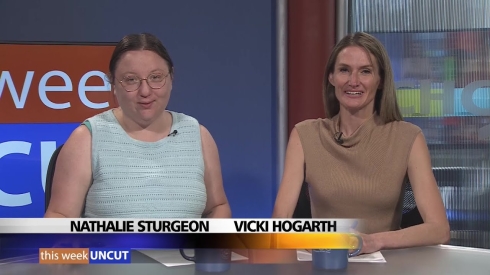
This Week Uncut on CHCO-TV: September 15-21, 2025

St. Stephen Committee of the Whole Tackles Active Transportation, Tent Concerns, and Budget Planning

St. Andrews Artist Ted Michener Turns Cancer Journey into Humour-Filled Book for Patients




Commentaires
Nous encourageons les commentaires qui favorisent le dialogue sur les histoires que nous publions. Les commentaires seront modérés et publiés s'ils respectent ces lignes directrices:
Le portail des médias communautaires se réserve le droit de rejeter tout commentaire ne respectant pas ces normes minimales.