


- Start playing the video
- Click CC at bottom right
- Click the gear icon to its right
- Click Subtitles/CC
- Click Auto-translate
- Select language you want
"To Share, Not Surrender": Understanding the Douglas Treaties on Vancouver Island
Life on Gabriola TV’s “Learning with Syeyutsus . . . revisited” series continues with an episode focused on the Douglas Treaties on Vancouver Island.
"Learning with Syeyutsus" is a project of the Nanaimo Ladysmith Public Schools district, in collaboration with UBC Press and the Vancouver Island Regional Library. The project's Facebook page defines "Syeyutsus" (See-YA-yut-sus) as "a Hul’q’umi’num expression for 'walking together': living and honouring the teachings of the land and first peoples while navigating the ever-changing complexities of today’s world and society." The series was created in response to the recommendations of the Truth and Reconciliation Commission of Canada.
We asked Lisa Webster, a Gabriola Island resident of Mohawk/Deleware/Scottish descent, to choose some of her favourite past episodes of the series, which is now in its fourth season.
“I love this series,” she says in her introduction, “I just think it's a good jumping off point into greater learning and greater knowing about the issues that are affecting Indigenous peoples in British Columbia, Indigenous peoples within Canada, and really helping to provide a different perspective.”
In this episode from May 2022, scholars Peter Cook and Neil Vallance discuss the book “To Share, Not Surrender: Indigenous and Settler Visions of Treaty Making in the Colonies of Vancouver Island and British Columbia,” of which they are two of five editors. Says Webster, “Many people don't know that Vancouver Island and in particular Snuneymuxw have treaties called the Douglas Treaties. [It’s] really important that we understand and know what those treaties are, how they were made, what they were intended to do, and what the perspectives are from both the settler point of view, the government point-of-view, but also from the First Nations point-of-view, and in our case, on Gabriola, Snuneymuxw.”
In the latter part of the episode, Doug White from the Snuneymuxw First Nation in Nanaimo discusses the importance of knowing the “actual substance” of the treaty between the Crown and Snuneymuxw, and what the parties understood they had done.
Of the Douglas Treaties in general, White says that “this is one of the most important stories in our province, in our country, the story of these particular treaties and the progression and the arc that they've been on over the last hundred-and-whatever-it-is, 60, 70 years. It's truly amazing, and the issues that the Crown and Indigenous peoples were grappling with back then are the same issues we continue to grapple with today in BC.”
The episode begins with an opening prayer and song from Tsumqwatun “Lawrence” Mitchell of the Snaw-Na-Was First Nation.
Life on Gabriola TV is re-posting the episodes chosen by Lisa with the permission of Nanaimo Ladysmith Public Schools. The complete series may be viewed at https://trc57speakerseries.ca/ or at https://www.youtube.com/@SD68NanaimoLadysmith. You can register for upcoming webinars in the series at https://virl.bc.ca/syeyutsus/.
Watch for more "Learning with Syeyutsus ... revisited" episodes, with Lisa's introductions, coming up on Life on Gabriola TV.
Life on Gabriola TV is generously sponsored by:
The Gabriola Arts Council
The Haven, Gabriola Island
The Gabriola Media Society gratefully acknowledges that we operate on the traditional and unceded territory of the Snuneymuxw First Nation.
Add new comment

Based on Gabriola Island, one of the Gulf Islands in the Salish Sea of BC, Life on Gabriola TV provides programming for Gabriolans, by Gabriolans. We cover events and issues in our own community, including adjacent islands, and in the Salish Sea region generally.
Recent Media

No Quick Cure for Health Care on Gabriola Island

Gabriola is the setting of a new award winning Canadian feature film, Seagrass, made on Gabriola Island.
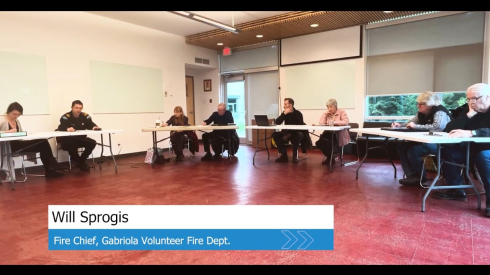
Public Input, EV Chargers and a Resignation: The March 6, 2024 meeting of the Gabriola Fire Protection Improvement District Trustees


We encourage comments which further the dialogue about the stories we post. Comments will be moderated and posted if they follow these guidelines:
The Community Media Portal reserves the right to reject any comments which do not adhere to these minimum standards.