
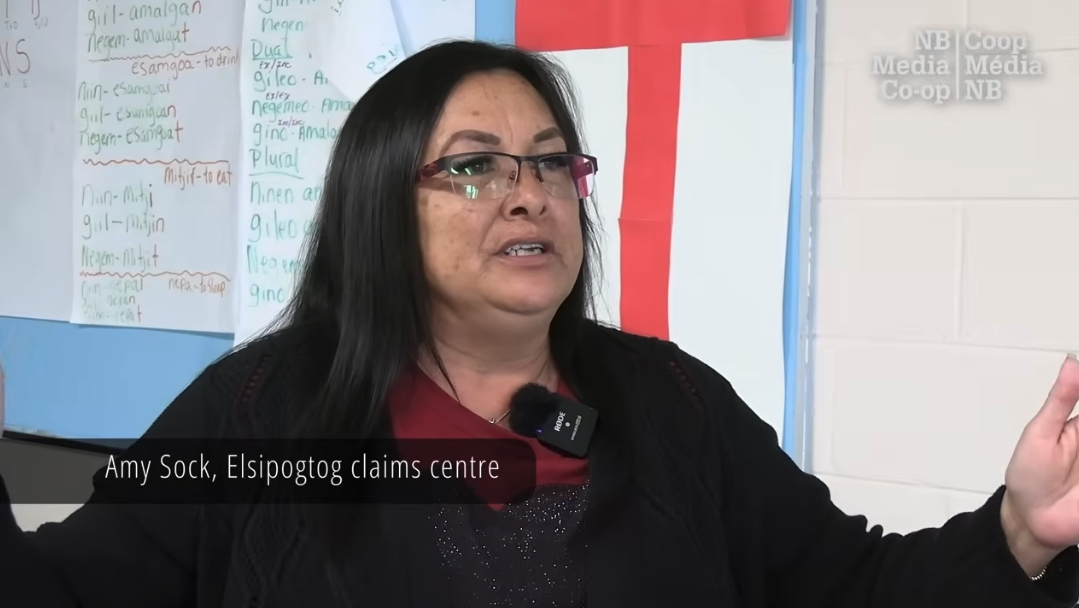
This summer, the NB Media Co-op hosted a series of media production workshops at Elsipogtog First Nation, about an hour north of Moncton. One participant, Lance Francis, an Elsipogtog community member and student at St. Thomas University, pitched a story that became one of the most-watched videos of the year.
The story featured an interview with Amy Sock, a lawyer who is working on two cases with significant implications for the community. The first, known as the 1824 Illegal Taking Claim, addresses the historic loss of reserve land due to settler encroachment. The second is a broader Indigenous title case that could reshape the legal relationship between Mi'kmaq First Nations and the Crown.
Lance’s interview updated the community on these cases, noting that Elsipogtog is close to a final settlement with the federal government (hence the headline: "Elsipogtog close to final settlement in 1824 Illegal Taking case"). Sock told the NB Media Co-op that a community referendum on the final settlement and its allocation is expected soon—potentially before next year’s band elections. She added that the larger Indigenous title case may take a decade to resolve.
The video quickly circulated on social media after its early July release, reaching more than 3,400 views on our YouTube channel—an unusually high number, as most stories rarely surpass a few hundred views. Community members also noted that the report sparked conversations locally and across nearby Mi'kmaq First Nations.
Several strong reports emerged from the NB Media Co-op’s monthly workshops, supported by the LJI program. Other examples included a report on a first-of-its-kind comic convention at Elsipogtog in August and a personal essay by another participant on his journey of self-acceptance as a two-spirit Mi'kmaw.
The workshops were attended by community members who had previously completed journalism courses taught by our LJI journalist through St. Thomas University’s Aotiitj program, which allows residents to take university courses on-reserve.
Some participants have expressed interest in continuing to work with our LJI journalist. The NB Media Co-op board recently set aside a small budget to continue these workshops over the coming year, made possible through the LJI program.
Ajouter un commentaire
A propos l’IJL
LJI Impact is the section of commediaportal.ca where the journalists and their organizations participating in CACTUS' Local Journalism Initiative can share their greatest successes.
Through the written stories, photos and videos you see in the LJI Impact section, you'll be able to read first hand accounts about how the presence of a community journalist is making a difference in communities across Canada through the Local Journalism Initiative and the Community Media Portal.
The Community Media Portal is a gateway to the audio-visual media created by community media centres across Canada. These include traditional community TV and radio stations, as well as online and new media production centres.
Community media are not-for-profit production hubs owned and operated by the communities they serve, established both to provide local content and reflection for their communities, as well as media training and access for ordinary citizens to the latest tools of media production, whether traditional TV and radio, social and online media, virtual reality, augmented reality or video games.
The Community Media Portal has been funded by the Local Journalism Initiative (the LJI) of the Department of Canadian Heritage, and administered by the Canadian Association of Community Television Users and Stations (CACTUS) in association with the Fédération des télévisions communautaires autonomes du Québec (the Fédération). Under the LJI, over 100 journalists have been placed in underserved communities and asked to produce civic content that underpins Canadian democratic life.


