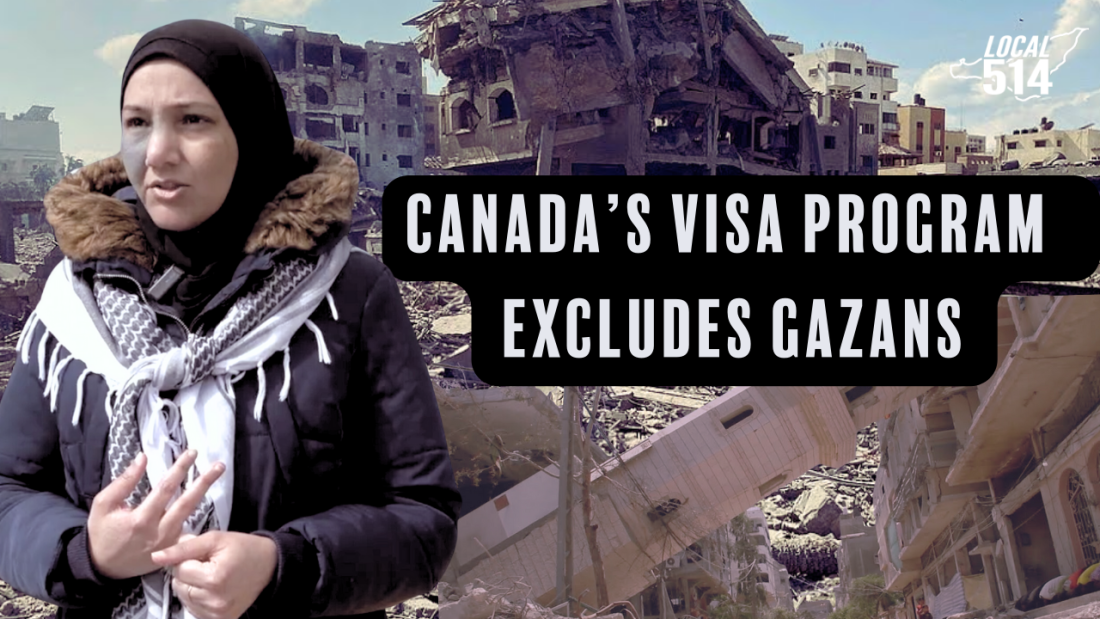
Canada unveiled the Special measures for extended family in Gaza on January 9, 2024. Through this temporary resident visa program, Gazans with family members who are either Canadian citizens or permanent residents can apply to come to Canada for up to three years. Not one applicant has been brought from Gaza to Canada under this program, prompting outrage from Canadians with family members in Gaza who are worried for the safety of their families. Now as the Israeli army carries out ground invasions in Rafah, the only border crossing that Palestinians can flee from is blocked, making it unlikely more Gazans can leave Gaza and have the ability to come to Canada.
Recent figures from Gaza’s health ministry say more than 34 thousand Gazans have been killed by Israel since Oct. 7. Two-thirds of those identified in the death toll are women and children.
If it's not the risk of being shot by the Israeli military during ground invasions or bombed by an airstrike, it's a risk of disease or famine. The north of Gaza is the most food insecure, with 55% in catastrophic levels of food insecurity in the north. The World Food Program has sounded the alarms for imminent famine, while top U.S. officials say famine has already begun in the north. On top of this, at the end of March, Israel confirmed that they would no longer allow UNRWA food convoys to go to the North of Gaza.
Local 514 followed the stories of three different families who have applied for their loved ones to come to Canada as refugees through these temporary measures. All three families are at different stages of their application and none of them have made it to Canada.
This is an impact story as it shows the realities of the living conditions Gazans are experiencing through video footage and the difficulty Palestinians in Montreal are experiencing waiting for a lack of response from the government and trying to support their family in Gaza to flee the violence safely. Minimal comprehensive support has been conducted since the information came to light that Canada cannot confirm how many Gazans have come to Canada through this program, leading Canadians to be left with the understanding that no Gazans have completed this program. As the government continues to avoid accountability for the failure of this program, this report is important to highlight the plight of both Palestinians in Gaza and Palestinians here in Montreal.
Add new comment
About LJI
LJI Impact is the section of commediaportal.ca where the journalists and their organizations participating in CACTUS' Local Journalism Initiative can share their greatest successes.
Through the written stories, photos and videos you see in the LJI Impact section, you'll be able to read first hand accounts about how the presence of a community journalist is making a difference in communities across Canada through the Local Journalism Initiative and the Community Media Portal.
The Community Media Portal is a gateway to the audio-visual media created by community media centres across Canada. These include traditional community TV and radio stations, as well as online and new media production centres.
Community media are not-for-profit production hubs owned and operated by the communities they serve, established both to provide local content and reflection for their communities, as well as media training and access for ordinary citizens to the latest tools of media production, whether traditional TV and radio, social and online media, virtual reality, augmented reality or video games.
The Community Media Portal has been funded by the Local Journalism Initiative (the LJI) of the Department of Canadian Heritage, and administered by the Canadian Association of Community Television Users and Stations (CACTUS) in association with the Fédération des télévisions communautaires autonomes du Québec (the Fédération). Under the LJI, over 100 journalists have been placed in underserved communities and asked to produce civic content that underpins Canadian democratic life.


