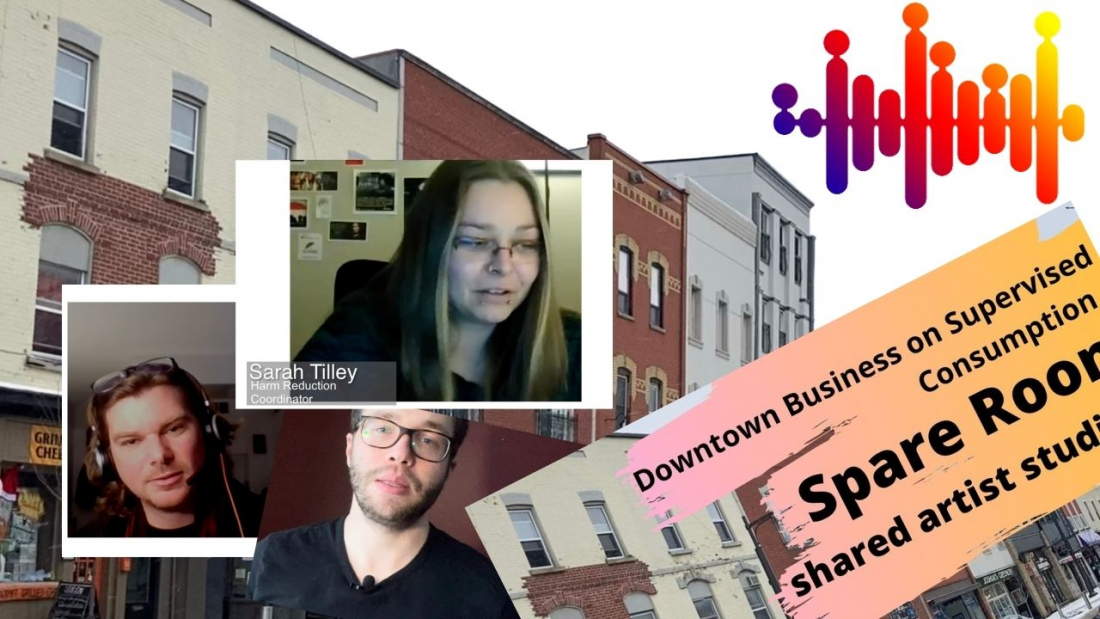
How does community media carve out a niche in a community with established media? As a brand new community media organization, the past months have been stuffed with learning more about answers to that question.
While programming schedules, membership policies and more have all been moving forward, we’ve dived into conversations with community members.
After all, conversation is a cornerstone of any community. Those conversations have helped us establish our focus. And crafting ways to empower the conversation-havers, has been a great challenge in these physically-distanced days of COVID-19.
One area we’ve focused on in the first months of BCM is the toxic opioid supply. It’s an issue that’s been covered often by local print and video news organizations -- so what could Barrie Community Media hope to add to the conversation? How could we contribute, shift the focus or raise new questions?
The short answer? we’re still finding out.
The long answer? We decided to start by talking to people and sharing their conversations in full. We’ve spoken to harm reduction coordinators, mental health advocates, addictions counselors, local politicians, downtown businesses, and many more.
The most impactful conversations -- the ones shared most widely -- are always interviews that touch on the personal side of the crisis.
After all, it’s a health crisis that harms the person who dies from toxic opioids, but also the family and friends. And we've heard throughout the past months how this nation-wide crisis has left friends and family confused and angered by, they say, a lack of action on the part of politicians and health care systems.
Sam Gillett, LJI Journalist for Barrie says, "It’s through long-form content that I, at least, learn the most. While news stories and even feature articles can share the tragic impact of the toxic supply crisis, conversations with family members, and learning alongside educators and harm reduction workers has provided a way for Barrie Community Media to add to Barrie’s coverage of the crisis.
Without our platform, there are limited ways (especially in a pandemic) in which these community members can share their voices without being mediated by Twitter algorithms, or Facebook comments.
While our reach so far is small, we’re growing. And messages we get, retweets, or comments have helped reassure me we’re on the right path. Our content is resonating with the community.
In a medium-sized -- and growing -- city, we’re hoping we can continue the momentum we’ve gathered so far.
I’ve based my reporting on just that: momentum. Starting slowly -- learning, talking and building trust -- I feel like our reporting can gain the foundation to provide Barrie with really valuable, reflective content.
Viewing every challenge, such as the Opioid crisis, as ongoing issues rather than stories to dip in and out of, has informed everything Barrie Community does so far."
Ajouter un commentaire
A propos l’IJL
LJI Impact is the section of commediaportal.ca where the journalists and their organizations participating in CACTUS' Local Journalism Initiative can share their greatest successes.
Through the written stories, photos and videos you see in the LJI Impact section, you'll be able to read first hand accounts about how the presence of a community journalist is making a difference in communities across Canada through the Local Journalism Initiative and the Community Media Portal.
The Community Media Portal is a gateway to the audio-visual media created by community media centres across Canada. These include traditional community TV and radio stations, as well as online and new media production centres.
Community media are not-for-profit production hubs owned and operated by the communities they serve, established both to provide local content and reflection for their communities, as well as media training and access for ordinary citizens to the latest tools of media production, whether traditional TV and radio, social and online media, virtual reality, augmented reality or video games.
The Community Media Portal has been funded by the Local Journalism Initiative (the LJI) of the Department of Canadian Heritage, and administered by the Canadian Association of Community Television Users and Stations (CACTUS) in association with the Fédération des télévisions communautaires autonomes du Québec (the Fédération). Under the LJI, over 100 journalists have been placed in underserved communities and asked to produce civic content that underpins Canadian democratic life.