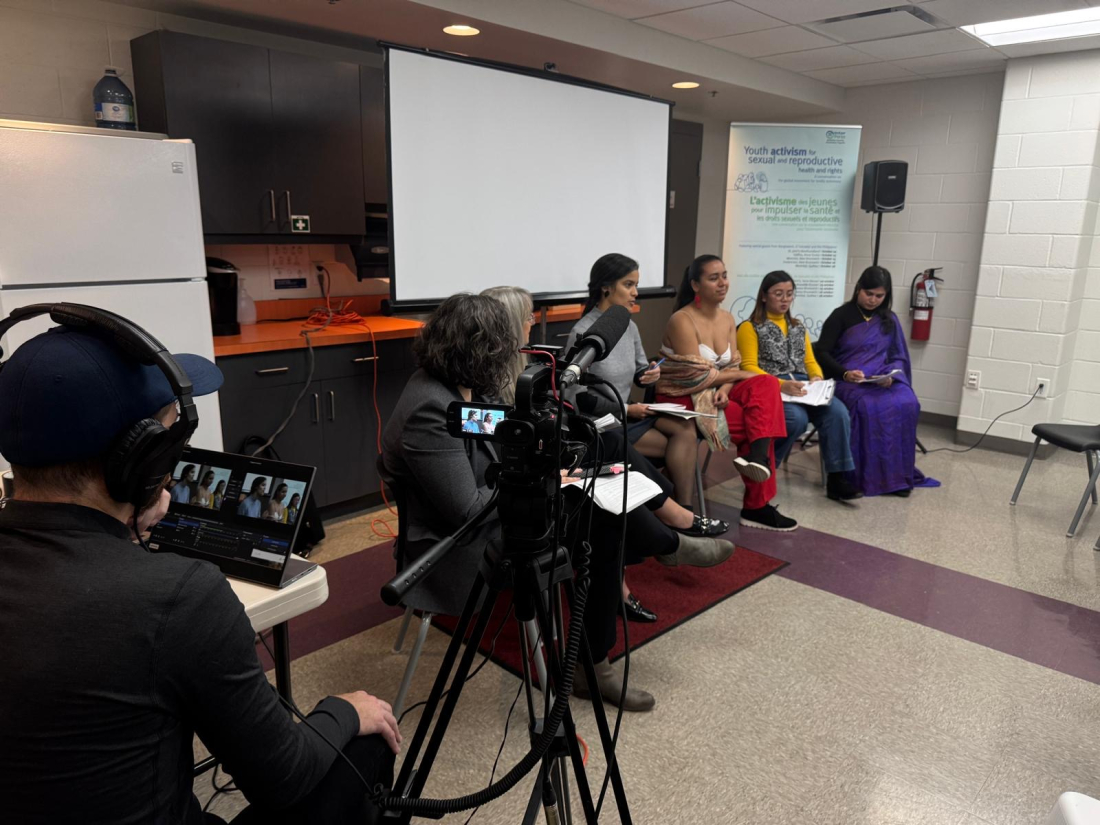
Young activists from Bangladesh, the Philippines and El Salvador recently toured Eastern Canada to raise awareness about the global movement for sexual and reproductive health and rights.
David Gordon Koch – Local Journalism Initiative
The panel discussions were organized by the Ottawa-based group Inter Pares and local co-sponsors including the NB Media Co-op. When the tour arrived in Moncton, we helped the organizers amplify their message by livestreaming the entire event, which is now archived on our website. The event had a special significance in New Brunswick, a province where teenage pregnancy rates are almost double the national average.
One of the organizers told us the webcast was a big boost for their efforts. “Livestreaming of the event allowed many colleagues and supporters, in Canada and abroad, to watch the event and allowed the voices of the experts to reach a much wider audience,” said Rita Morbia, co-manager of Inter Pares, in an email to the NB Media Co-op.
“Having the event on YouTube will help Inter Pares amplify the messages and the experience of the public event, even beyond what we expected with the five-city tour,” she said. The overall online audience, including those who watched via livestream and those who watched the archived version, was several times greater than the original in-person event.
In October, we also webcasted an event in Moncton which brought together several political party leaders to discuss gender equality and economic issues affecting women. This is only a beginning. We hope to host livestreams more often as our organization grows in capacity.
We were able to livestream these events using a professional camcorder connected to a laptop with streaming software. This equipment, in turn, was operated by a full-time journalist on the NB Media Co-op staff.
This work has been made possible in part with funding from the Government of Canada's Local Journalism Initiative, administered by the Canadian Association of Community Television Stations and Users (CACTUS). The program involves passing on video production skills to volunteers, helping to build a stronger community.
As we reflect on the past year and look forward to 2025, we can see that social justice movements face immense challenges, notably an emboldened neofascist movement following the re-election of Donald Trump in the United States.
When it comes to reproductive rights alone, the situation south of the border is looking increasingly dire. We need media watchdogs connected to social justice movements to challenge these trends. The Local Journalism Initiative contributes to these efforts.
Ajouter un commentaire
A propos l’IJL
LJI Impact is the section of commediaportal.ca where the journalists and their organizations participating in CACTUS' Local Journalism Initiative can share their greatest successes.
Through the written stories, photos and videos you see in the LJI Impact section, you'll be able to read first hand accounts about how the presence of a community journalist is making a difference in communities across Canada through the Local Journalism Initiative and the Community Media Portal.
The Community Media Portal is a gateway to the audio-visual media created by community media centres across Canada. These include traditional community TV and radio stations, as well as online and new media production centres.
Community media are not-for-profit production hubs owned and operated by the communities they serve, established both to provide local content and reflection for their communities, as well as media training and access for ordinary citizens to the latest tools of media production, whether traditional TV and radio, social and online media, virtual reality, augmented reality or video games.
The Community Media Portal has been funded by the Local Journalism Initiative (the LJI) of the Department of Canadian Heritage, and administered by the Canadian Association of Community Television Users and Stations (CACTUS) in association with the Fédération des télévisions communautaires autonomes du Québec (the Fédération). Under the LJI, over 100 journalists have been placed in underserved communities and asked to produce civic content that underpins Canadian democratic life.


